




THALIA
Sensitive Nanoparticle Analysis for Biopharmaceutical Applications
- Particularly suited for small nanoparticles
- Supports aggregation monitoring
- Real-time particle size data in seconds
- Non-invasive measurement for closed and process-relevant workflows
- Optional Large Particle Detection for detecting larger particles and aggregates
What is the NanoFlowSizer THALIA?
The THALIA is a high-sensitivity NanoFlowSizer system for real-time nanoparticle size analysis, where conventional approaches can be limited by low concentration, small particle size, or delicate dispersions. It is built for users who need more representative particle size information with minimal handling, whether in formulation work, stability studies, or process development. The THALIA is designed for applications where high sensitivity is essential, especially in low-concentration formulations and protein-related measurements.
Key considerations in sensitive nanoparticle size analysis
In low-concentration and protein-based formulations, obtaining representative particle size data is not always straightforward. Analytical workflows can become less reliable when the signal is weak, when particles begin to aggregate, or when sample handling changes the material before measurement. The THALIA is designed for these situations, where sensitivity, speed, and non-invasive analysis are especially valuable. This is especially relevant for proteins, monoclonal antibodies, and other sensitive formulations.

Weak signals at low concentration
Smaller particles and dilute formulations can be difficult to characterize consistently with conventional workflows.

Handling can change the sample
Dilution, transfer steps, or repeated handling may alter delicate dispersions before they are measured.

Aggregation can be difficult to detect early
Delayed or offline methods can make it harder to detect size shifts or early aggregation in time.

Larger particles are not always visible in average size trends
Average size trends do not always reflect the presence of larger particles or aggregates in protein formulations.
Why choose the NanoFlowSizer THALIA?
The THALIA is designed for applications involving smaller nanoparticles, low-concentration formulations, and protein-based systems where subtle size changes and aggregation behavior matter. It is particularly relevant for monoclonal antibodies, therapeutic proteins, and similar formulations that require sensitive, non-invasive analysis.
The platform can also be extended with Large Particle Detection when rare larger particles or aggregates are important to follow alongside the main nanoparticle population.
The THALIA is a strong fit for
- Protein-based formulations
- Monoclonal antibodies and related therapeutics
- Stability screening
- Aggregation monitoring
- Low-concentration nanoparticle systems
- Applications that benefit from Large Particle Detection
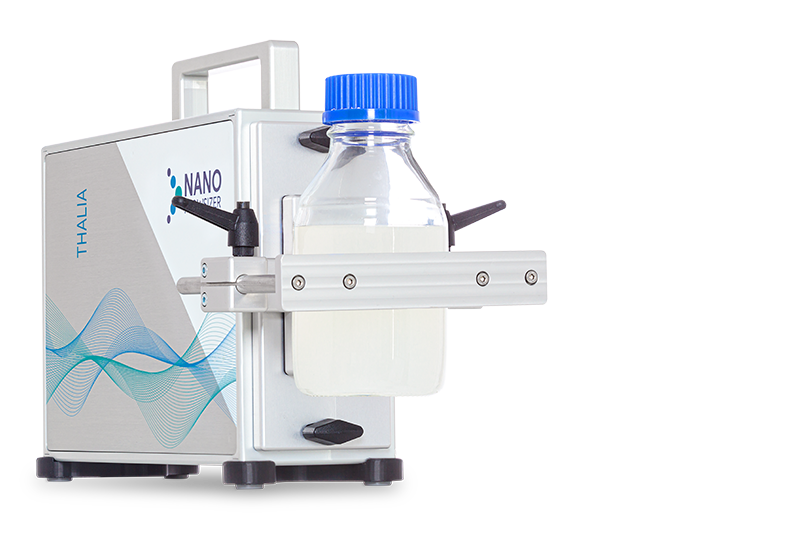
NanoFlowSizer THALIA
Key benefits
- High sensitivity for low-concentration formulations
- Real-time particle size feedback
- Sample stability screening
- Better visibility into aggregation behavior
- Non-invasive measurement
- Optional Large Particle Detection for larger particles and aggregates
Typical application areas
- Protein therapeutics
Follow particle size and aggregation behavior in protein-based formulations where sensitivity and gentle analysis are important. - Monoclonal antibodies and related therapeutics
Support development and stability work for mAbs and related therapeutic formats. - Stability screening
Monitor how formulation or process conditions influence particle size over time, without relying on heavy sample preparation. - Aggregation monitoring
Detect size shifts during formulation development, screening, or process evaluation to better understand aggregation risk. - Large Particle Detection
Add optional LPD when insight into larger particles is important. This capability is especially valuable in protein measurements, where aggregates may not be fully reflected by average size information alone. - Formulation screening
Use the THALIA during formulation studies and design-of-experiments work where fast, non-invasive feedback supports better comparison between conditions.
“The NanoFlowSizer proves to be a valuable PAT tool”
Optional Large Particle Detection for protein aggregation monitoring
For applications where aggregation is a key concern, the THALIA can be expanded with Large Particle Detection. LPD is an optional imaging-based capability on the NanoFlowSizer that enables direct detection, quantification, and monitoring of large particles in suspensions and biopharmaceutical formulations. It is a non-invasive method that works alongside SR-DLS measurements and helps reduce the time needed to detect aggregation.
This is especially valuable in protein measurements, where even a limited number of larger particles or subvisible aggregates can be relevant while the main size distribution still appears stable. By combining THALIA’s sensitive size analysis with optional LPD, users gain a broader view of both the main particle population and emerging aggregation events.
Software and platform options
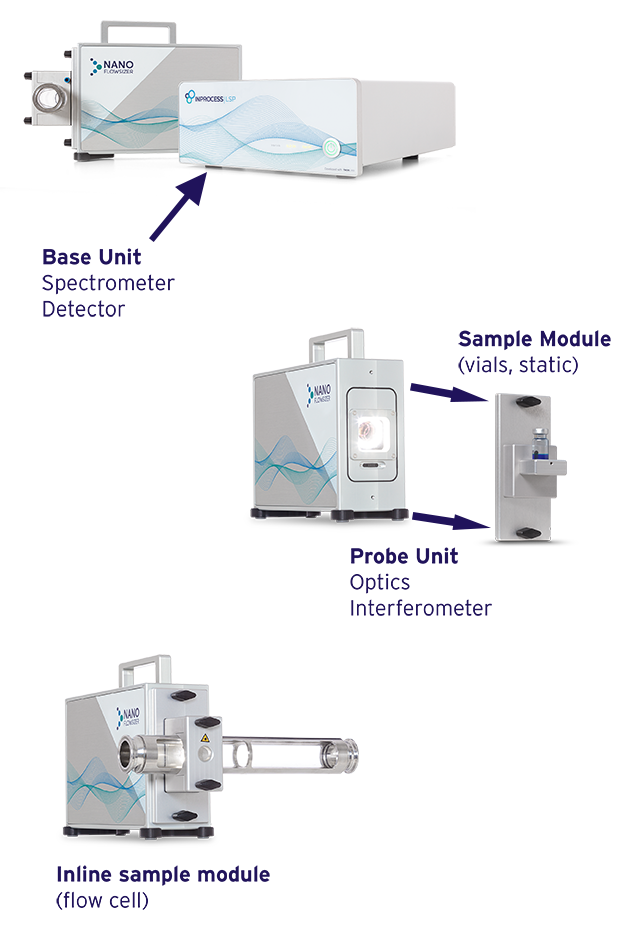
The THALIA is supported by XsperGo software and can be configured for different scales and workflows. THALIA is supported by XsperGo software and can be configured for different scales and workflows. The platform supports GMP-compliant and OPC-UA-compatible environments and can be expanded with options such as PhaSR and Large Particle Detection.
- XsperGo software for data handling and workflow support
- GMP-compliant and OPC-UA-compatible environment
- Optional PhaSR for very low particle size and low-concentration applications
- Optional Large Particle Detection for larger particles and aggregates
Key specifications
| System feature | THALIA |
|---|---|
| Measurement principle: | Spatially Resolved Dynamic Light Scattering (SR-DLS) |
| Particle Size Range: | 3 nm – 5000 nm |
| Measurement angle: | 180° backscatter |
| Measuring mode: | Flow & static |
| Configuration: | Inline, online, at-line, offline |
| Data collection: | real-time/continuous <5 sec per datapoint |
| Flow rate: | <250 L/hr |
| Wavelength: | 1250 to 1350 nm |
| Turbidity*: | Real-time/continuous <5 sec per datapoint |
| Sample size: | >1 ml |

Need better visibility into particle size and aggregation in sensitive formulations?
The THALIA helps to measure nanoparticles in low-concentration and protein-based formulations with greater sensitivity and less disruption. When larger particles and aggregates matter, optional Large Particle Detection adds another layer of insight.
“Accurate particle sizing is key for nanomedicine;
the NanoFlowSizer makes it a real-time reality”
